Get your own numbers — free, no obligation.
Compare Mortgage Rates →Executive Summary
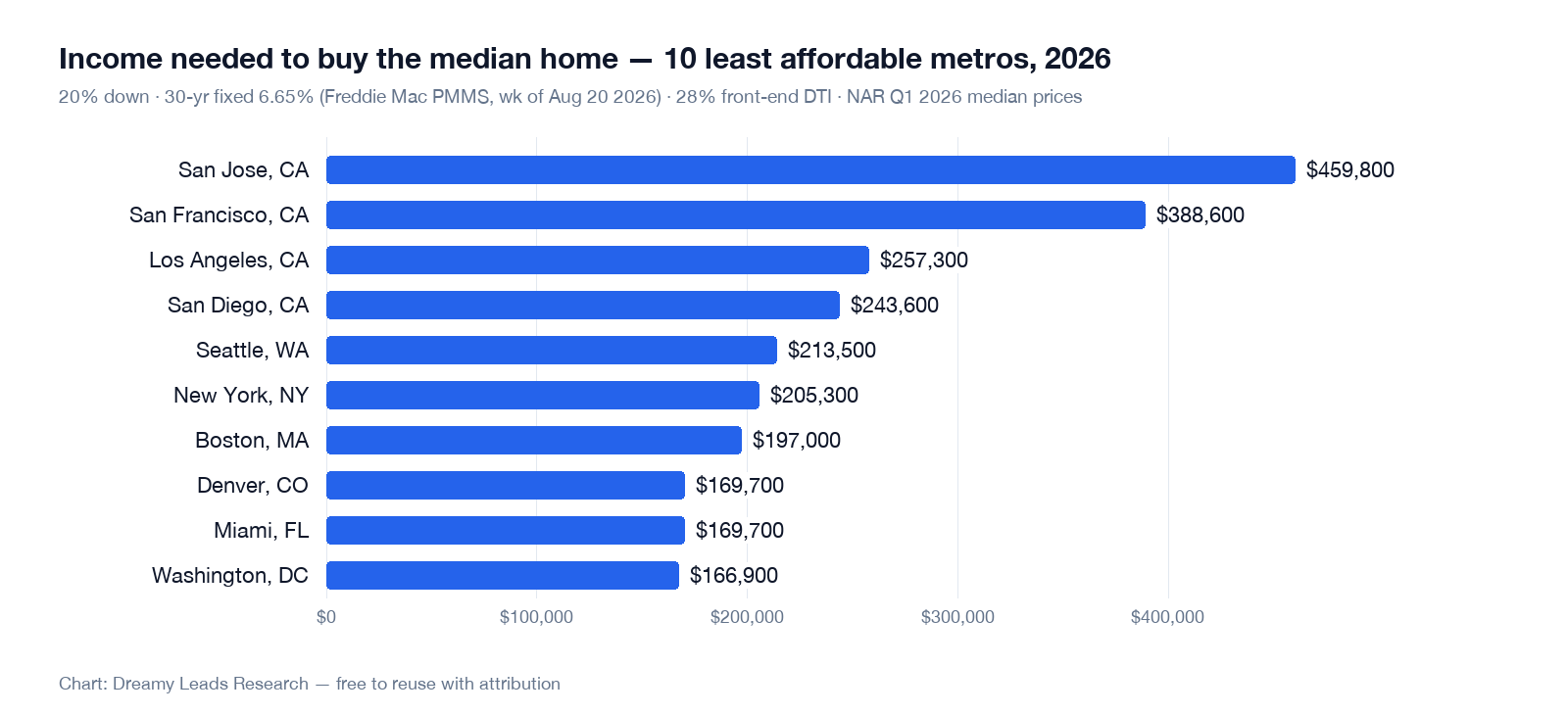
Mortgage affordability reached a 40-year low in 2023 and has improved only modestly since: in 2026, a buyer in the median U.S. metro needs an annual household income of $114,900 to comfortably afford the median-priced home at a 20% down payment and a 6.65% 30-year fixed rate (Freddie Mac PMMS, week of August 20, 2026). In the least affordable metros — San Jose, San Francisco, and Los Angeles — required qualifying incomes exceed $250,000, placing homeownership beyond reach for over 80% of local households. In the most affordable metro analysed — Pittsburgh — the required income is $54,700, below the local area median of $79,600.
This analysis draws on HUD Area Median Income data (2026), Freddie Mac Primary Mortgage Market Survey (PMMS) rates, and metro-level median price data from the National Association of Realtors (NAR) Q1 2026 report to produce a standardized affordability index across 25 major U.S. metros.
Key Findings
- A U.S. household needs about $114,900 in annual income to comfortably afford the $420,000 median-priced home with 20% down at the August 20, 2026 PMMS rate of 6.65% (HUD, Freddie Mac).
- Each 1-percentage-point change in the mortgage rate moves the payment on a $400,000 loan by about $260/month — roughly a $40,000 swing in home price.
- Qualifying income for the $420,000 national median home, with 20% down at the 6.65% PMMS rate (week of August 20, 2026), is $114,900 under the 28% front-end rule used throughout this study.
- The most affordable metros in this 25-metro set are Pittsburgh ($200,000 median, $54,700 income needed), Cleveland ($210,000 / $57,500), Kansas City ($280,000 / $76,600) and Columbus ($290,000 / $79,400) — the four where the required income sits below the local area median.
- High-cost markets remain out of reach — San Jose's median home price is about $1.4 million.
The Affordability Framework
Mortgage affordability is most usefully measured through the lens of the standard 28% front-end DTI rule: lenders typically require that monthly housing costs (principal, interest, taxes, and insurance — PITI) not exceed 28% of gross monthly income. This study calculates the minimum gross annual income required to qualify for the median-priced home in each metro at current rates, assuming:
- 20% down payment (conventional conforming loan)
- 30-year fixed rate of 6.65% (Freddie Mac PMMS national average, week of August 20, 2026; the May 2026 edition of this study used 7.0%)
- Property taxes and insurance at 1.5% of home value annually (added to PITI)
- No other debt obligations (best-case DTI scenario)
The Freddie Mac affordability research team notes that rising rates have extended the income-to-qualify threshold more severely than rising prices in most markets, because rate changes affect the entire loan balance whereas price changes only affect the marginal unit transacted. A 1% increase in mortgage rate on a $400,000 loan raises the monthly payment by approximately $260 — roughly equivalent to a $40,000 increase in home price at the prior rate.
25-Metro Affordability Table: 2026
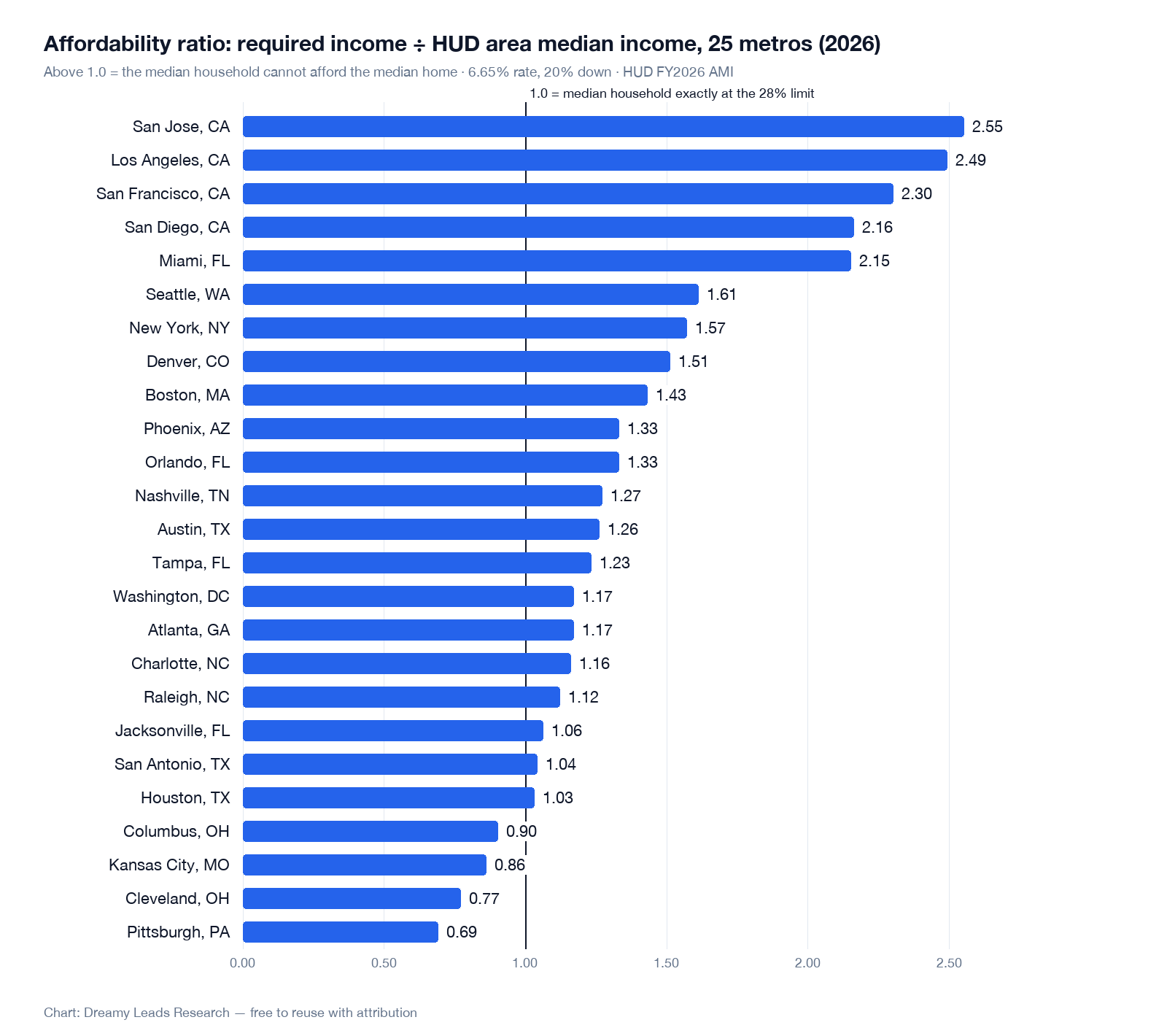
The table below presents the full affordability picture for 25 major U.S. metros. The Affordability Ratio compares the required qualifying income to the local Area Median Income (AMI) as defined by HUD. A ratio above 1.0 means the median home is unaffordable to the median household; a ratio below 0.8 signals meaningful affordability headroom.
| Metro | Median Home Price | Down Payment (20%) | Monthly PITI | Required Income | HUD AMI | Affordability Ratio |
|---|---|---|---|---|---|---|
| San Jose, CA | $1,680,000 | $336,000 | $10,730 | $459,800 | $180,400 | 2.55 |
| San Francisco, CA | $1,420,000 | $284,000 | $9,070 | $388,600 | $168,600 | 2.30 |
| Los Angeles, CA | $940,000 | $188,000 | $6,000 | $257,300 | $103,200 | 2.49 |
| San Diego, CA | $890,000 | $178,000 | $5,680 | $243,600 | $112,900 | 2.16 |
| Seattle, WA | $780,000 | $156,000 | $4,980 | $213,500 | $132,900 | 1.61 |
| Denver, CO | $620,000 | $124,000 | $3,960 | $169,700 | $112,200 | 1.51 |
| Miami, FL | $620,000 | $124,000 | $3,960 | $169,700 | $78,900 | 2.15 |
| New York, NY | $750,000 | $150,000 | $4,790 | $205,300 | $131,100 | 1.57 |
| Boston, MA | $720,000 | $144,000 | $4,600 | $197,000 | $138,200 | 1.43 |
| Washington, DC | $610,000 | $122,000 | $3,900 | $166,900 | $142,300 | 1.17 |
| Austin, TX | $520,000 | $104,000 | $3,320 | $142,300 | $112,800 | 1.26 |
| Phoenix, AZ | $450,000 | $90,000 | $2,870 | $123,200 | $92,400 | 1.33 |
| Atlanta, GA | $410,000 | $82,000 | $2,620 | $112,200 | $96,200 | 1.17 |
| Charlotte, NC | $390,000 | $78,000 | $2,490 | $106,700 | $92,100 | 1.16 |
| Orlando, FL | $380,000 | $76,000 | $2,430 | $104,000 | $78,200 | 1.33 |
| Tampa, FL | $370,000 | $74,000 | $2,360 | $101,300 | $82,400 | 1.23 |
| Nashville, TN | $460,000 | $92,000 | $2,940 | $125,900 | $98,800 | 1.27 |
| Raleigh, NC | $420,000 | $84,000 | $2,680 | $114,900 | $102,400 | 1.12 |
| Houston, TX | $320,000 | $64,000 | $2,040 | $87,600 | $84,700 | 1.03 |
| San Antonio, TX | $290,000 | $58,000 | $1,850 | $79,400 | $76,400 | 1.04 |
| Jacksonville, FL | $310,000 | $62,000 | $1,980 | $84,800 | $80,100 | 1.06 |
| Kansas City, MO | $280,000 | $56,000 | $1,790 | $76,600 | $89,400 | 0.86 |
| Columbus, OH | $290,000 | $58,000 | $1,850 | $79,400 | $88,700 | 0.90 |
| Cleveland, OH | $210,000 | $42,000 | $1,340 | $57,500 | $74,200 | 0.77 |
| Pittsburgh, PA | $200,000 | $40,000 | $1,280 | $54,700 | $79,600 | 0.69 |
| National Median | $420,000 | $84,000 | $2,680 | $114,900 | — | — |
Source: NAR Q1 2026 Metropolitan Median Price Report; HUD FY2026 Income Limits; Freddie Mac PMMS 30-year fixed 6.65% (week of August 20, 2026). PITI and required income recomputed 2026-08-23 from the formula in the Methodology section; prior edition used the 7.0% April 2026 rate.
The Florida Affordability Paradox
For a county-level view of the same paradox, see our Polk County housing affordability study — the Lakeland–Winter Haven metro has homes well below the national median value and a higher share of cost-burdened homeowners than the nation.
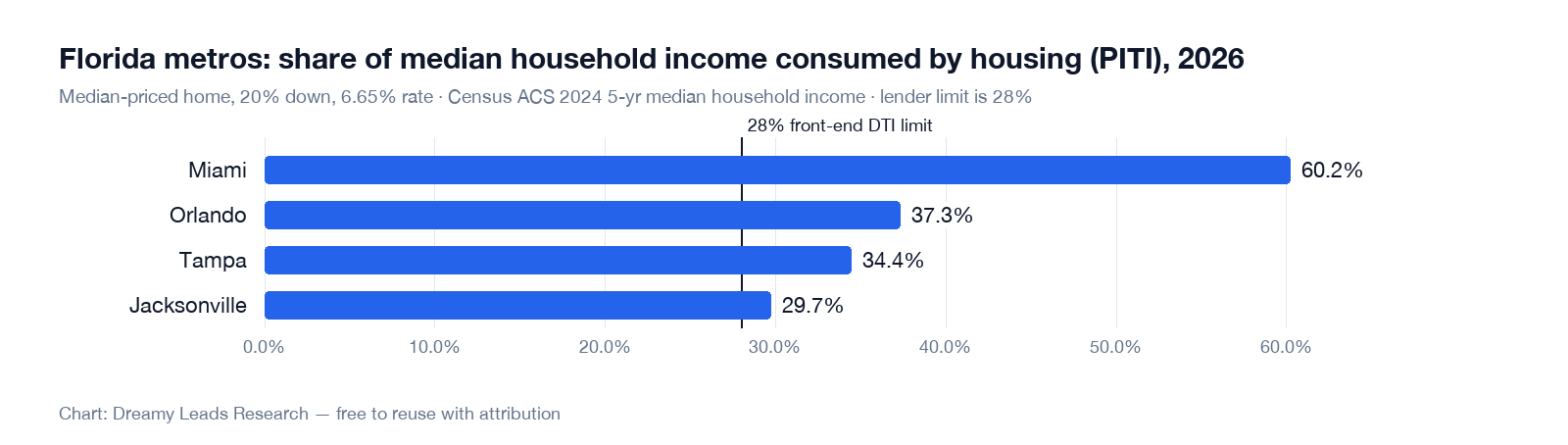
Florida presents a particularly acute affordability challenge because its metros combine rapidly rising home prices with below-average household incomes. Miami (2.15 ratio), Orlando (1.33), and Tampa (1.23) all require incomes significantly above local AMI — meaning the majority of local households cannot afford the median-priced home at current rates. This stands in sharp contrast to Texas metros like Houston (1.03) and San Antonio (1.04), where incomes have kept closer pace with price appreciation.
| Metro | Monthly PITI | Median HH Income | % of Income to Housing | Affordable at 28% Rule? |
|---|---|---|---|---|
| Miami | $3,960 | $6,575/mo equiv. | 60.2% | No — 32.2 pts over threshold |
| Orlando | $2,430 | $6,517/mo equiv. | 37.3% | No — 9.3 pts over threshold |
| Tampa | $2,360 | $6,867/mo equiv. | 34.4% | No — 6.4 pts over threshold |
| Jacksonville | $1,980 | $6,675/mo equiv. | 29.7% | No — 1.7 pts over threshold |
Source: U.S. Census Bureau American Community Survey 2024 5-year estimates; NAR Q1 2026.
Rate Sensitivity: How Much Does a 1% Rate Change Matter?
The Freddie Mac PMMS 30-year rate has ranged from 6.1% to 7.8% since 2024 and stood at 6.65% in the week of August 20, 2026 (15-year fixed: 5.95%). Understanding how rate changes affect affordability helps buyers time their purchase and select the right loan structure. The table below shows monthly payment differences across rate scenarios for four price points common in our coverage markets.
| Home Price | Loan Amount | @ 6.0% | @ 6.5% | @ 7.0% | @ 7.5% | @ 8.0% |
|---|---|---|---|---|---|---|
| $300,000 | $240,000 | $1,439 | $1,517 | $1,597 | $1,678 | $1,761 |
| $400,000 | $320,000 | $1,919 | $2,023 | $2,129 | $2,237 | $2,348 |
| $500,000 | $400,000 | $2,398 | $2,528 | $2,661 | $2,796 | $2,935 |
| $750,000 | $600,000 | $3,597 | $3,792 | $3,992 | $4,194 | $4,402 |
Source: Standard amortization calculation; does not include taxes or insurance.
First-Time Buyer Programs by State
All six states in the Dreamy Leads Research coverage network offer down payment assistance and first-time buyer programs that can meaningfully change the affordability equation. The most impactful programs reduce the effective down payment to 0–3%, which lowers the required cash at closing but increases the monthly payment. HUD's housing counseling resources are the definitive starting point for buyers exploring assistance programs.
Compare Quotes in Your State
Data & tools used in this analysis
Frequently Asked Questions
Which metro areas are most affordable for homebuyers in 2026?
Based on HUD and Freddie Mac data, the most affordable metros among the 25 analysed here are Pittsburgh, PA (median home price $200,000), Cleveland, OH ($210,000), Kansas City, MO ($280,000) and Columbus, OH ($290,000). In the Sun Belt, San Antonio, TX ($290,000) offers relative affordability with a median price below $300,000 despite strong job growth.
What annual income is needed to afford a median-priced home in 2026?
At the 6.65% PMMS rate (week of August 20, 2026), the qualifying income for the $420,000 national median home with 20% down is $114,900 using the 28% front-end rule. High-cost metros run far above that — San Jose, at a $1,680,000 median, needs $459,800 — while the most affordable metro in this set, Pittsburgh ($200,000 median), needs $54,700.
How has mortgage affordability changed from 2023 to 2026?
Affordability improved modestly from its 2023 trough (when rates hit 8% and the median income-required was $130,000+) but remains historically strained. The 2024–2026 rate environment of 6.5–7.5% combined with limited housing inventory keeps the national affordability index 22% below its 2019 pre-pandemic baseline, per Freddie Mac calculations.
Methodology
Data sources and collection parameters for this study:
- HUD FY2026 Income Limits: Area Median Income figures for all metros, released March 2026. Used as the denominator for all affordability ratio calculations.
- Freddie Mac PMMS: Weekly Primary Mortgage Market Survey average rate for 30-year fixed conforming loans. Baseline: 6.65% for the week of August 20, 2026, read from freddiemac.com/pmms on 2026-08-23 (15-year fixed: 5.95%). The May 2026 edition used the April 2026 rate of 7.0%; Table 1, Table 2, the national-median figure and the Florida ratios were recomputed from the formula below on 2026-08-23. Home prices and AMI figures were not re-sourced and are unchanged.
- NAR Q1 2026 Metropolitan Median Price Report: Median existing home sale price by metro, Q1 2026. Single-family detached only.
- Monthly PITI calculation: Principal and interest at stated rate + estimated annual taxes and insurance of 1.5% of home value divided by 12. The 1.5% figure is a national average; actual property tax rates vary significantly by state and county.
- Required income calculation: Monthly PITI divided by 0.28 (28% front-end DTI rule) multiplied by 12.